How to Run the Heist
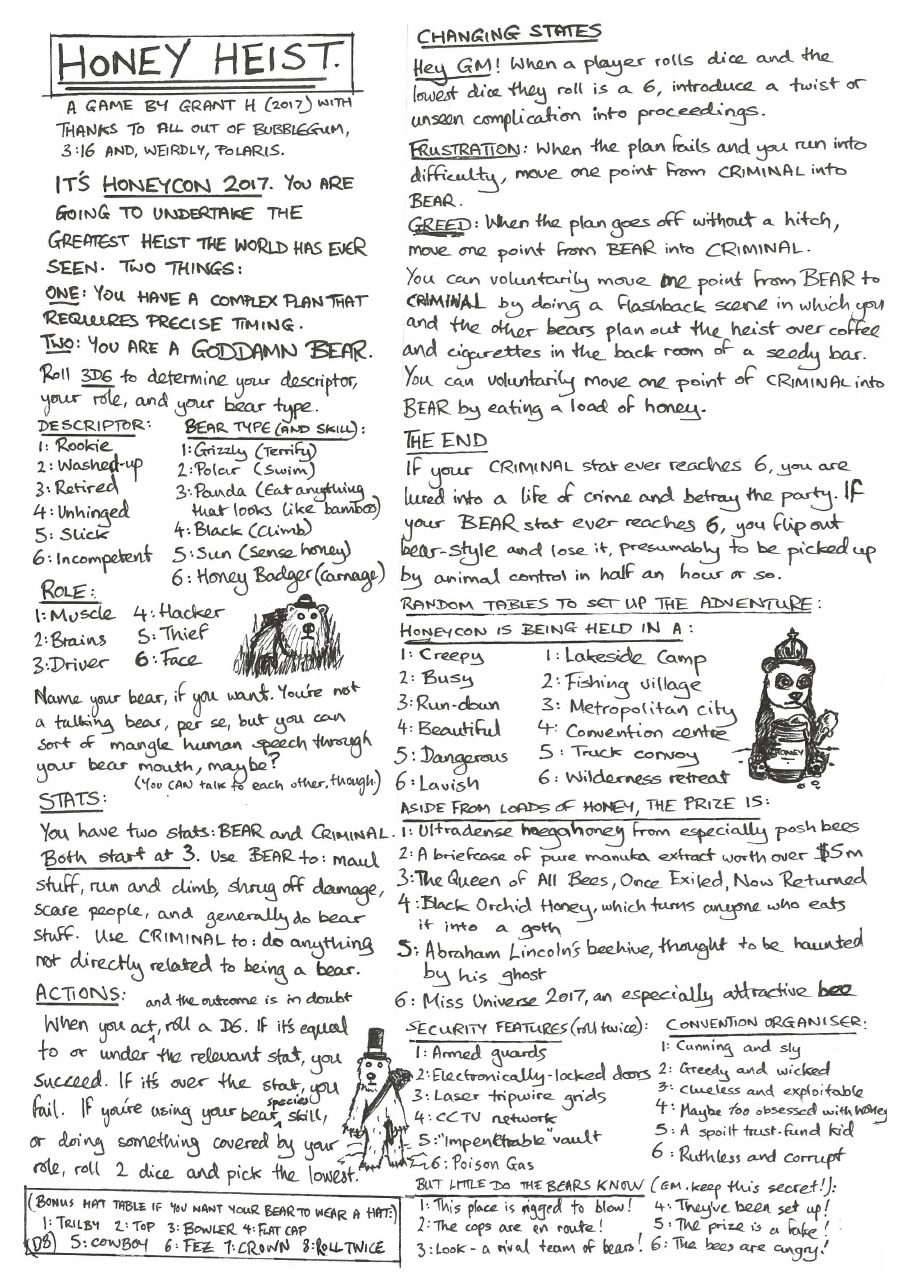
A guide for first-time GMs. Honey Heist fits on two pages because the rules aren't where the game lives. Most of it lives in how you ask for rolls, what you do when they fail, and how fast you let the plan fall apart. This tab walks through a whole session, gives you dozens of rulings to borrow, and ends with an annotated play report.
1 · The shape of a session
A one-shot runs 1½–3 hours. Every session moves through the same six beats. You don't need to announce them, but knowing where you are tells you what to do next.
- The pitch (2 min). Read the hook aloud: it's Honeycon 2017, the plan needs precise timing, and you are a goddamn bear. Set the tone right away: this is a heist movie played completely straight, and everyone in it is a bear.
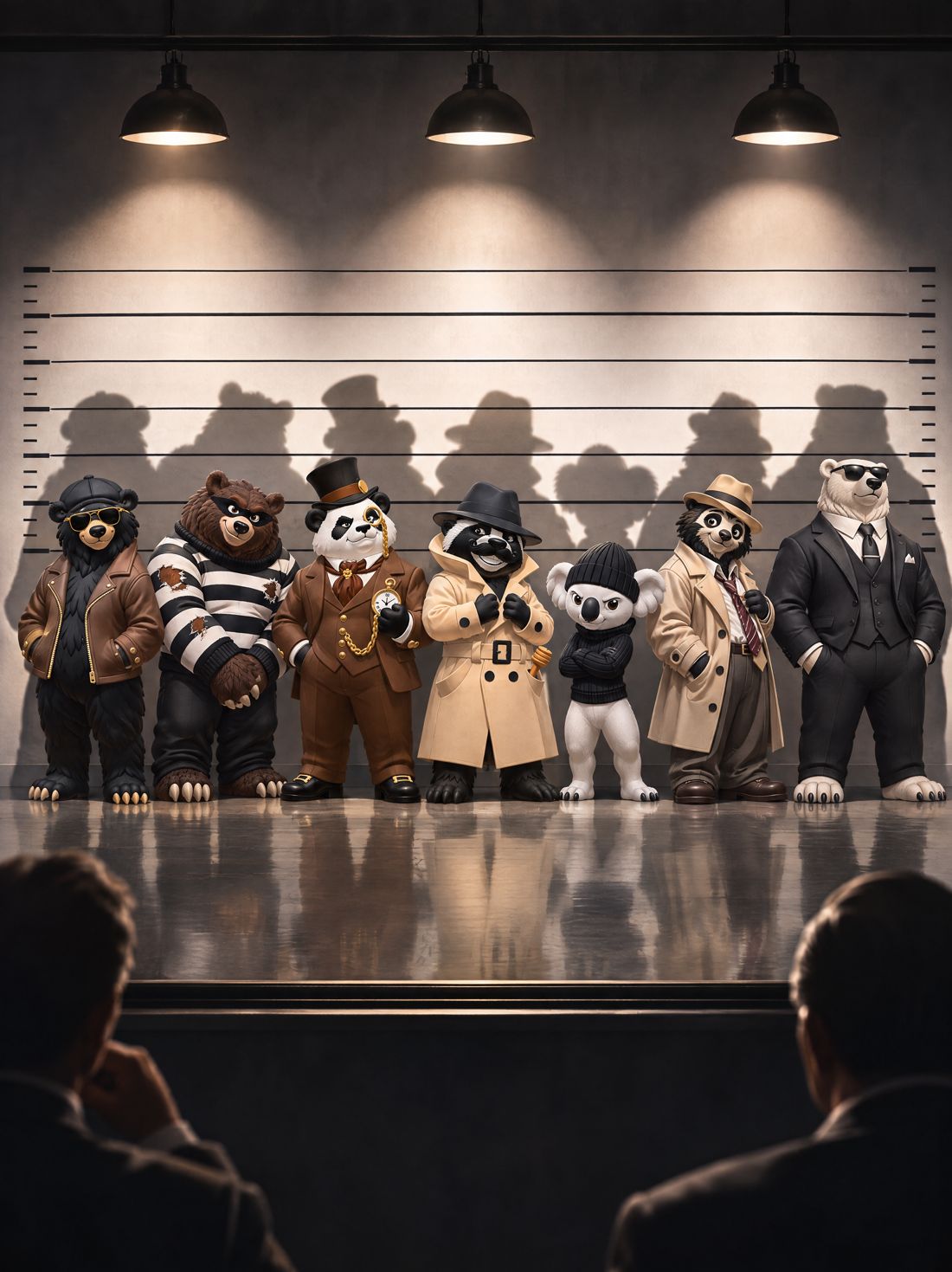
- Make bears (10 min). Everyone rolls 3d6 for descriptor, bear type and role, plus the optional hat. Have each player say their bear's name and one thing they're bringing to the job. Both stats start at 3. That's the whole character sheet.
- Roll the job (5 min). Roll the GM tables in front of everyone except the twist, which you keep secret. Read out the location, the prize, the organiser and the two security features. That's the target.
- The plan (15–20 min). Let the players plan the heist, then cut them off before they finish. A half-made plan is perfect. Every gap becomes a flashback later, and every over-detailed step is something for you to break.
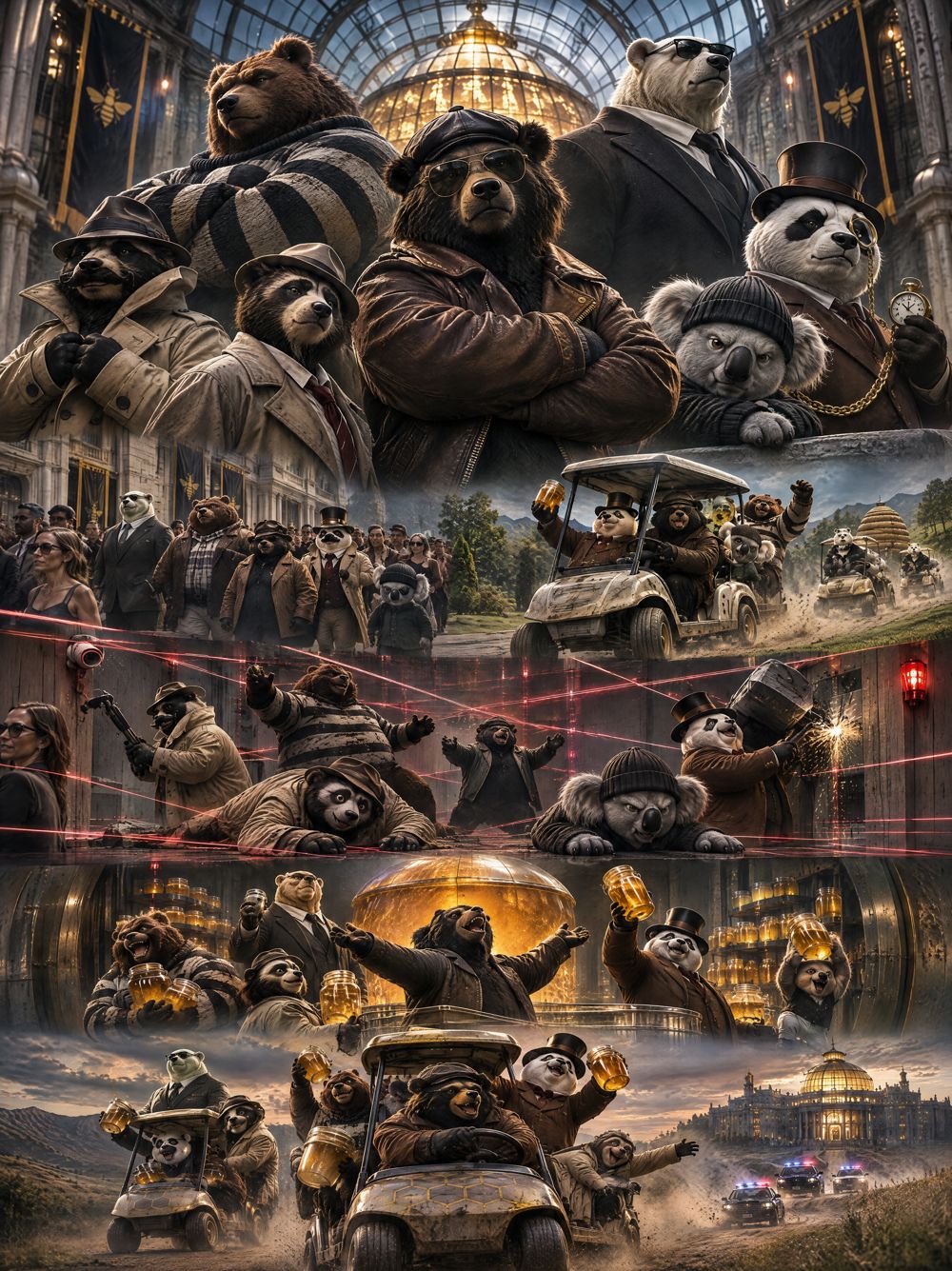
- The job (60–90 min). Start in motion, at the first step of the plan. Run it scene by scene. Let the plan work just long enough for the players to feel clever, then reveal the twist, usually about halfway through.
- The getaway & epilogue (10 min). Get out with the prize, or don't. Close with a quick "where are they now?" for each bear, especially anyone who betrayed the crew or flipped out.
2 · Your job as GM
- Describe the world, then ask "what do you do?" End nearly every turn of narration with that question, aimed at a specific bear.
- You never roll. Humans, guards and lasers have no stats. Players make every roll, and you decide what the result means.
- Say yes, or roll the dice. If a bear's idea could plausibly work and nothing's at stake, it just works. If there's real risk, they roll. Don't block a plan just because it's silly; silly is the point.
- Play the humans straight. Guards should be oddly slow to notice that the "visiting dignitary" is a bear in a trilby. Every human in the world should be one strong reaction away from screaming.
- Keep it moving. A heist is about momentum. If the table stalls, push something at them: footsteps, a phone ringing, a guard coming back early.
- Spotlight everyone. Each role should get at least one scene where it's the obvious answer. The Driver should drive. The Hacker should hack something ridiculous.
3 · When to roll (and when not to)
Call for a roll only when both of these are true:
- The outcome is in doubt: it could believably go either way.
- Failure would be interesting: something happens, rather than nothing.
| Situation | Roll? | Why |
|---|---|---|
| A polar bear walks across an empty car park | No | Nothing to fail at. |
| A polar bear walks across a car park in front of a security booth | Yes: Criminal | Being spotted changes the scene. |
| Opening an unlocked door | No | No doubt. |
| Opening a locked door quietly before the guard turns round | Yes: Criminal | Doubtful, and the timing matters. |
| Eating honey | No | It's a voluntary stat shift. Bears are very good at eating honey. |
| Eating honey while hanging upside down from a ceiling vent | Yes: Bear | The honey is easy. The hanging is the problem. |
| Trying the same failed lock again with nothing changed | No | The failure stands. Change the approach (smash it, find a key, flash back to a bribe) and you can roll again. |
One roll resolves one intention, not one movement. "I sneak past the desk, up the stairs and into the server room" is a single Criminal roll if the danger is the same all the way. Split it into two rolls only if the dangers are different.
4 · Bear or Criminal?
The book's rule of thumb: Bear is for anything a bear does by being a bear. Criminal is for everything else. When you're stuck, ask the player how they're doing it. The description usually decides the stat.
Bear: body, instinct, fear
- Smashing, breaking, lifting, throwing
- Running, climbing, swimming, jumping
- Scaring, roaring, intimidating by size
- Shrugging off harm: bullets, gas, falls, bees
- Smelling, tracking, sensing
- Eating something absurd, quickly
Criminal: craft, cunning, cool
- Sneaking, hiding, staying unnoticed
- Lock-picking, hacking, cracking safes
- Disguises, lies, bluffs, fast talk
- Driving well (as opposed to driving through things)
- Spotting a guard's patrol pattern, reading a blueprint
- Pickpocketing, sleight of paw, forgery
- Keeping to the plan under pressure, including not eating the honey right now
The same goal can use either stat. That's the core of the system. Getting past a guard can mean sneaking past (Criminal), sweet-talking past (Criminal), or picking him up and putting him in a bin (Bear). Let the player choose. Their choice says what kind of bear they're becoming, and the stat shifts will push them further that way.
| Stat | 1 | 2 | 3 | 4 | 5 |
|---|---|---|---|---|---|
| 1d6 | 17% | 33% | 50% | 67% | 83% |
| 2d6, keep lowest | 31% | 56% | 75% | 89% | 97% |
5 · Skills, roles and the 2d6 roll
Roll 2d6 and keep the lowest when the action uses the bear's special skill or fits their role. It's a single bonus: having both doesn't add a third die. Be generous. If the player can explain in one sentence why it fits their role, it fits.
| Skill / role | Clearly fits | A stretch, but allow it | Doesn't fit |
|---|---|---|---|
| Grizzly · Terrify | Roaring a guard into fleeing | Glaring at a vending machine until it gives up a snack | Picking a lock |
| Polar · Swim | Crossing the lake unseen | "Swimming" through a ball pit or a vat of honey | Climbing a fence |
| Panda · Eat bamboo-likes | Eating a guard's baton | Eating the laser emitter, since it's sort of a stick | Eating a door (not a stick) |
| Black · Climb | Scaling the building | "Climbing" through a ventilation shaft | Hacking a terminal |
| Sun · Sense Honey | Finding the prize | Smelling which guard had honey on his toast (he's the bribable one) | Driving |
| Honey Badger · Carnage | Wrecking a room full of guards | "Carnage" through a locked door | Sweet-talking anyone |
| Muscle | Holding a door shut, lifting a safe | Intimidating a mid-level manager | Forging documents |
| Brains | Reading blueprints, improvising a new plan | Calculating whether a guard's coffee will run out in four minutes | Out-wrestling another bear |
| Driver | The getaway | Steering a runaway luggage cart, a forklift, or another bear | Lying to a receptionist |
| Hacker | Cameras, locks, lasers | Rewiring the PA system to play whale song | Swimming |
| Thief | Pickpocketing, sneaking, safecracking | Stealing the guard's sandwich mid-bite as a distraction | Smashing through a wall |
| Face | Disguises, fast talk | Convincing a rival bear to switch sides | Climbing a cliff |
6 · Making failure fun
A failed roll should never mean "nothing happens." Failure moves the story forward and makes things worse. Pick one of these, or combine a few:
| Consequence | Example |
|---|---|
| It works, but at a cost | The lock opens, but the alarm panel starts beeping. You have one minute. |
| It doesn't work, and things get worse | The disguise slips, and now the receptionist is reaching for the phone. |
| Someone notices | A guard looks up. On the grid: Heat +1. |
| Someone gets hurt | The guard opens fire. That bear rolls Bear to shrug it off. |
| You lose something | The crowbar, the keycard, the van keys, your hat. Never the hat if you can help it. |
| The plan breaks | The step the plan relied on is now impossible. Time for Frustration. |
| Bear nature takes over | You were sneaking past the buffet and now you're eating the buffet. |
Before the dice are rolled, it helps to say what's at stake: "If this fails, the guard turns round." Then the players choose with their eyes open, and the failure feels fair.
7 · The stat-shift engine
The four stat shifts are the heart of the game. Every point that moves makes a bear better at one thing and worse at the other, and pulls them toward one of two endings.
| Shift | Direction | Who triggers it | When to call it |
|---|---|---|---|
| Frustration | Criminal → Bear | GM | When the plan fails, not a single roll. A missed lock is just a failure. The vault being empty, the getaway van being towed, or the inside man turning out to be a cop: that's Frustration. Usually it hits the bears who were counting on that part of the plan. On the grid, it hits everyone at Heat 4. |
| Greed | Bear → Criminal | GM | When part of the plan goes off without a hitch. Reward a clean step: the camera loop held, the bluff worked perfectly. Easy wins make bears greedy. |
| Flashback | Bear → Criminal | Player | A player can call one any time: "Cut to the bar three nights ago…" They play out a short scene that explains why something is about to work. The flashback costs a point toward Criminal, so it's never free. |
| Honey | Criminal → Bear | Player | Any time there's honey within reach. Bears do this to boost Bear before a big physical roll, which pushes them toward flipping out. |
Endings aren't failures. A bear who hits Criminal 6 betrays the party. Let the player decide how, and give them a moment of villainy. A bear who hits Bear 6 flips out. Describe the rampage gloriously. If there's plenty of session left, the player can roll up a new bear who shows up "as backup," or take over the guards for the rest of the job.
8 · Example rulings
Borrow these as they are, or use them to calibrate your own calls. "2d6" means the roll uses 2d6 keep-lowest for the skill or role in brackets.
9 · Tricky calls
Two bears doing the same thing
One bear leads and rolls. If another bear helps in a way that clearly matters, the leader rolls 2d6 keep-lowest if they weren't already. A failure lands on both of them. Helping is a real risk.
The whole crew needs to do something (all sneak past, all jump the gap)
Have each bear roll, and count the failures. Zero: clean. One: something minor goes wrong (Heat +1, a dropped bag). Two or more: things go properly wrong. Players love to argue about whose fault it was.
A bear vs. a rival bear
Rival bears are bears, so they're stronger than humans. Taking one down needs a successful Bear roll, and it fights back: on a failure, the player's bear is Hurt. Outsmarting a rival is Criminal, and rival bears are surprisingly easy to bribe with honey.
A player wants to do something enormous in one roll
"I punch through the floor into the vault" is fine. Grant it with a big cost: Heat to 6, or a Frustration shift because it wasn't the plan. Big actions should change the situation, not skip it.
A stat is at 1 (or 0)
A stat of 1 succeeds 1 time in 6. That's intentional: the bear has drifted too far. Encourage the player to solve things with their other stat. A stat of 0 can't succeed, so the bear can only try the other way, and the game is telling you it's nearly over for them.
Talking to humans
Bears can sort of mangle human speech. Lean into it. A Criminal roll to bluff is perfectly fine, but describe how it sounds: "Hrrrello. Am… inspector. Of honey."
Disguises
Use the Human Believability Score when the question is simply does this human notice they're looking at a bear? The GM rolls 4d6 against the bear's HBS. The moment the bear opens its mouth to lie, it's a Criminal roll instead (2d6 for a Face). A failed HBS roll doesn't have to mean instant disaster: "Sir, are you… quite well?" is a fine middle ground.
Rules lawyers
There's almost nothing to argue about. If someone tries, offer a roll and move on. Speed matters more than accuracy here.
10 · When to use the grid
The grid is a tool for one set-piece, not the whole night. Bring out the map once the bears are inside the building and timing, sightlines and positioning start to matter. Put it away when the plan goes off the rails into a chase, or when the conversation becomes the scene.
- Use the grid for: sneaking past cameras, coordinating a split crew, the laser corridor, the vault, a fight in the lobby.
- Stay off the grid for: planning, flashbacks, social scenes, car chases, the epilogue.
- Rolls don't change on the grid. Same stats, same dice. The grid only adds positioning (who can see whom, how far you can get) and Heat as a visible fuse.
- Heat 4 is your Frustration trigger. It saves you deciding when the plan has failed: the track decides for you.
Which map? While the crew plans, show them the region map and the site map for the job's venue (on The Job tab and the Map tab) and let them pick their approach. When the break-in starts, lay out the painted battlemap's player layer and keep the GM layer to yourself. In the Metropolitan City, Hivesburg Tower has four floors: the crew can go up through the lobby or drop in from the roof.
11 · Play report: The Manuka Job
An illustrative session. The ROLL boxes show each roll as it happens: which stat, why, the dice, and what the GM did with the result. GM boxes show the GM's thinking. SHIFT boxes track stat changes.
Clawdia "Velvet": Slick Sun Bear, Face (Sense Honey). Bear 3 / Criminal 3. Fez.
Mitts: Rookie Black Bear, Hacker (Climb). Bear 3 / Criminal 3. Crown on top of a cowboy hat.
Scene 1 · The Back Room of the Stinking Elk
The plan, as written on a beer mat: Velvet walks in the front door as a VIP and opens the service entrance. Theo comes through it with an empty catering trolley. Mitts goes up the outside of the building, into the roof vents, and loops the cameras. They meet at the Platinum Lounge, swap the briefcase for an identical one full of jam, and leave through the loading dock before the 9 p.m. keynote.
"What about the lasers?" asked Mitts.
Nobody had an answer. The GM smiled and called time on planning.
Scene 2 · The Red Carpet
Velvet swept up the marble steps in a long coat, a fez and a lanyard reading CLAUDIA BEARSON — HONEY QUALITY INSPECTOR (FEDERAL). The woman at the VIP desk looked up, then up some more.
"Hrrname," said Velvet, sliding a business card across the desk with one claw. "Inspector. Very… important. Of honey."
Why Criminal: bluffing and disguise are craft, not muscle. Why 2d6: talking past the front desk is exactly what a Face does. Applied: the receptionist waves her into the VIP area and hands her a glass of champagne, which she eats, glass and all.
Velvet found the service corridor behind a velvet rope (she took this personally), padded to the fire door and shoved the bar. Theo was waiting outside with a trolley.
Scene 3 · Over the Top
On the north wall, Mitts had found a drainpipe. He looked down at the crown on top of his cowboy hat, decided it would stay on through sheer confidence, and started climbing.
Why Bear: scaling a wall is physical bear business. Why 2d6: climbing is the black bear's skill. Even with two dice, double sixes happen. Applied (fail forward): the GM doesn't say "you fall." Instead the drainpipe tears off the wall with Mitts still on it and swings him like a pendulum, straight through a third-floor window into the Platinum Lounge's kitchen. He's in, a floor below where he planned and very loudly. A chef stares at him, holding a ladle.
"Shhhh," said Mitts, holding a claw to his lips. The chef dropped the ladle and fainted into a tray of profiteroles.
Scene 4 · Flashback: The Lasers
Theo and Velvet wheeled the trolley to the Platinum Lounge corridor and stopped. A lattice of red light hummed across the passage.
"Ah," said Theo. Then he grinned, as well as a grizzly can grin. "Ah, but."
Three nights earlier. The Stinking Elk. Theo slid a jar of something cloudy across the table to a nervous man in an electrician's van uniform. "Fuse box. Ten o'clock. You flip it for ninety seconds, and you never saw a bear."
Scene 5 · The Grid Comes Out
The crew is inside and the timing matters, so the GM puts the battlemap on the table. Heat starts at 0.
Two cameras covered the Lounge doors. Mitts, upstairs in the kitchen with his laptop balanced on the fainted chef, went looking for the camera feed.
Why Criminal: hacking. Why 2d6: it's what Hackers do. On the grid, a Hacker can work cameras from up to 3 squares away, and the camera junction box is right under the kitchen floor. Applied: both cameras now show an empty corridor on a loop. The GM removes their vision cones from the map.
Theo pushed the trolley through the dark corridor at full grizzly speed. On the grid that's a Dash: 8 squares, no action. Velvet walked beside it, champagne-free, counting under her breath. "Eighty-one. Eighty-two…"
They made it with seconds to spare. Behind them the lasers flickered back on.
Scene 6 · The Platinum Lounge (The Twist)
The Lounge was gold leaf and velvet, with a single glass case in the middle under a spotlight. Inside it, the briefcase. Velvet's nose twitched.
"Manuka," she said. "And… something else. Wet fur. Cheap cologne."
Why Bear: smell is bear instinct. Notice that Velvet's Bear stat has dropped to 2 from the earlier Greed, so her skill die is doing a lot of work. Applied: the GM reveals the twist on Velvet's terms rather than springing it as an ambush. She smells three other bears in the ceiling, already lowering a rope toward the case. The GM flips the rival bear tokens to visible on the map.
Three bears in matching tracksuits slid down from the ceiling. The one in front, a brown bear with a gold chain, held up a paw.
"Kodiak Cartel," he rumbled. "Walk away, Velvet."
Velvet adjusted her fez. "Or. We split it. Fifty-fifty. Nobody has to get… mauled."
Why Criminal: negotiation. Applied: an 89% roll failed. It happens. The Cartel leader laughs and smashes the glass case. The noise is loud: Heat +1 → 1. A rival grabs the briefcase.
Scene 7 · Things Go Wrong
Theo didn't wait for a plan. He planted his feet, drew himself up to his full, retired, terrible height, and roared.
Why Bear: roaring is as bear as it gets. Note how the earlier flashback cost Theo: at Bear 3 this would have succeeded. Applied: the rival bears are bears; they're not impressed. But the humans are. Two guards burst in from the service door, see four bears and a smashed case, and start shouting into their radios. Heat +2 → 3 (one for the roar, one for being spotted).
Security turn. The guards levelled their tasers at the biggest target in the room: Theo.
"Tasers," said the GM. "Roll Bear to shrug it off."
Why Bear: soaking up damage is bear business. Why 1d6: being a Muscle doesn't help you ignore electricity. Applied (grid Hurt rule): Theo is knocked down (next turn he gets Move or Action, not both) and shifts Criminal → Bear: Theo is now Bear 3 / Criminal 3. Pain makes him more bear.
Upstairs, Mitts heard the shouting through the floor. He looked at the tray of profiteroles, at the fainted chef, at the industrial vat of honey glaze on the stove.
He put his whole face in it.
Then Mitts went through the floor. He didn't use the stairs or the vents. He went through the floor.
Why Bear: smashing through a floor is pure bear. Applied: Mitts lands on top of the rival carrying the briefcase, which counts as taking down a rival bear: a successful Bear roll. The briefcase skids across the floor. Smashing is loud: Heat +1 → 4.
Scene 8 · The Swap
Velvet and the Cartel leader dived for the briefcase at the same moment. Velvet's hand closed on the handle. So did his.
"Kodiak," Velvet purred, "look behind you."
He did not look behind him. He looked at the trolley, where the identical jam-filled briefcase sat on top.
Why Criminal: sleight of paw plus a con. Why Face: it's a con. The table could have argued for Thief, but a Face can sell a con, so the GM allowed it. Applied: in the scuffle, Velvet lets go of the real briefcase and "loses" a tug-of-war over the jam one. The Cartel leader triumphantly holds up the decoy, signals his crew, and they're hauled back up into the ceiling. The real briefcase is under the trolley's tablecloth.
Scene 9 · The Getaway
The service corridor was full of guards. The loading dock was shuttered. Theo, still smoking slightly from the taser, looked at the shutter and cracked his neck.
Why Bear + Muscle: tearing a steel shutter out of its frame is literally the Muscle's job. Notice how much better Theo got at this as his Bear stat climbed. Applied: the shutter goes. Outside sits a catering van with its engine running and nobody in it.
Nobody in the crew was a Driver. Velvet got behind the wheel anyway and adjusted the mirror. "How hard can it be?"
Why Criminal: driving well, as in getaway driving, is a crime skill. Ramming things would have been Bear. Why 1d6: she's a Face, not a Driver. Applied: the van screeches out of the dock, past three police cars arriving the other way, and into the night.
Epilogue
The GM went round the table.
Theo (Bear 4 / Criminal 2) retired again, this time for real, to a cabin with a very good lock. Mitts (Bear 5 / Criminal 1) made the evening news as "the crowned bear" and is now, technically, wanted. Velvet (Bear 3 / Criminal 3) kept the briefcase in her lap all the way home and didn't let anyone else hold it.
And somewhere across town, the Kodiak Cartel opened their prize and found five million dollars' worth of strawberry jam.
Tally
| Rolls | 11 rolls: 7 successes, 4 failures. No failure stopped the story. Each one made it go somewhere new. |
|---|---|
| Stat shifts | Greed ×1, Flashback ×1, Honey ×1, Hurt ×1, Frustration ×3 (all at once at Heat 4). |
| Skill / role rolls | 8 of 11. A generous GM keeps the 2d6 roll common, which keeps the bears competent and the scenes fun. |